ART & CULTURE What's in Nguyễn Văn Trinh's "Living Zone" - By Luxuo
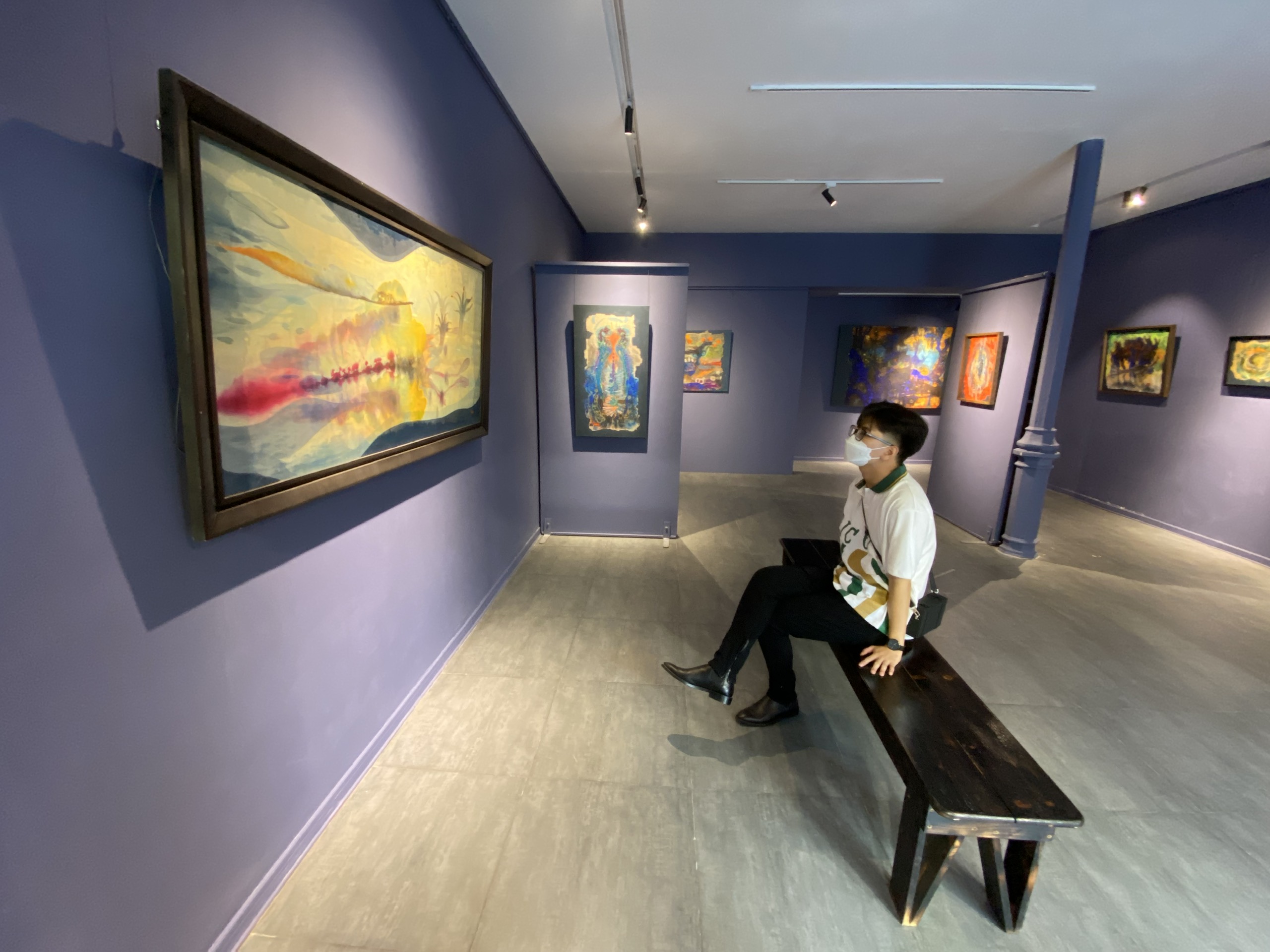
Through his silk creations, and particularly in the exhibition "Living Zone 2" at The Muse Art Space, using Giang paper, Nguyễn Văn Trinh has shown the audience his unconventional pioneering spirit in art.
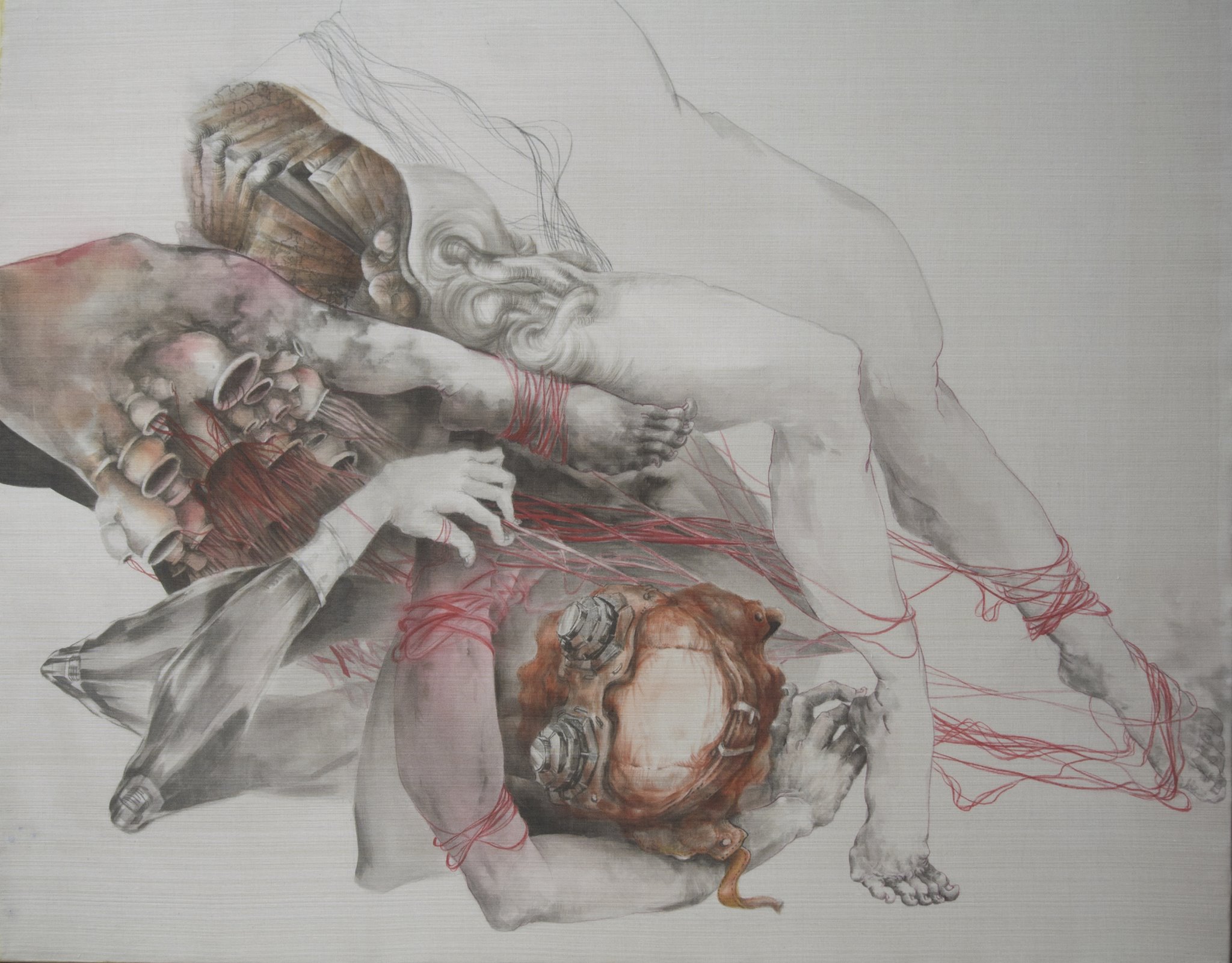
Nguyễn Văn Trinh, “Collision” (2015), watercolor on silk, 70 x 90 cm. Photo credit: The artist.
Nguyễn Văn Trinh's emotional journey has also traversed paths of realism, impressionism, surrealism... as the artist says: "there was a time when I saw a beautiful tree and wanted to paint it, but achieving that didn't mean sticking with it forever." Strange forms began to appear in Trinh's works around 2014. It was a progressive world inspired by machines invading humanity. But what is remarkable is that these rigid forms were created on traditional silk. At this point, readers can probably already imagine a distinctive personality.
Hello painter Nguyễn Văn Trinh. I am very impressed by your silk works from 2014-2015, depicting bodies combined with machines. Can you tell us how that idea originated?
It's my preference, who I am, my worldview. When I paint these things, I feel more connected to myself, compared to painting pressing social issues, or something too heavy culturally or locally... I do what I deeply like, it's easier to reach emotions. And painting the rigid on silk creates a balance.
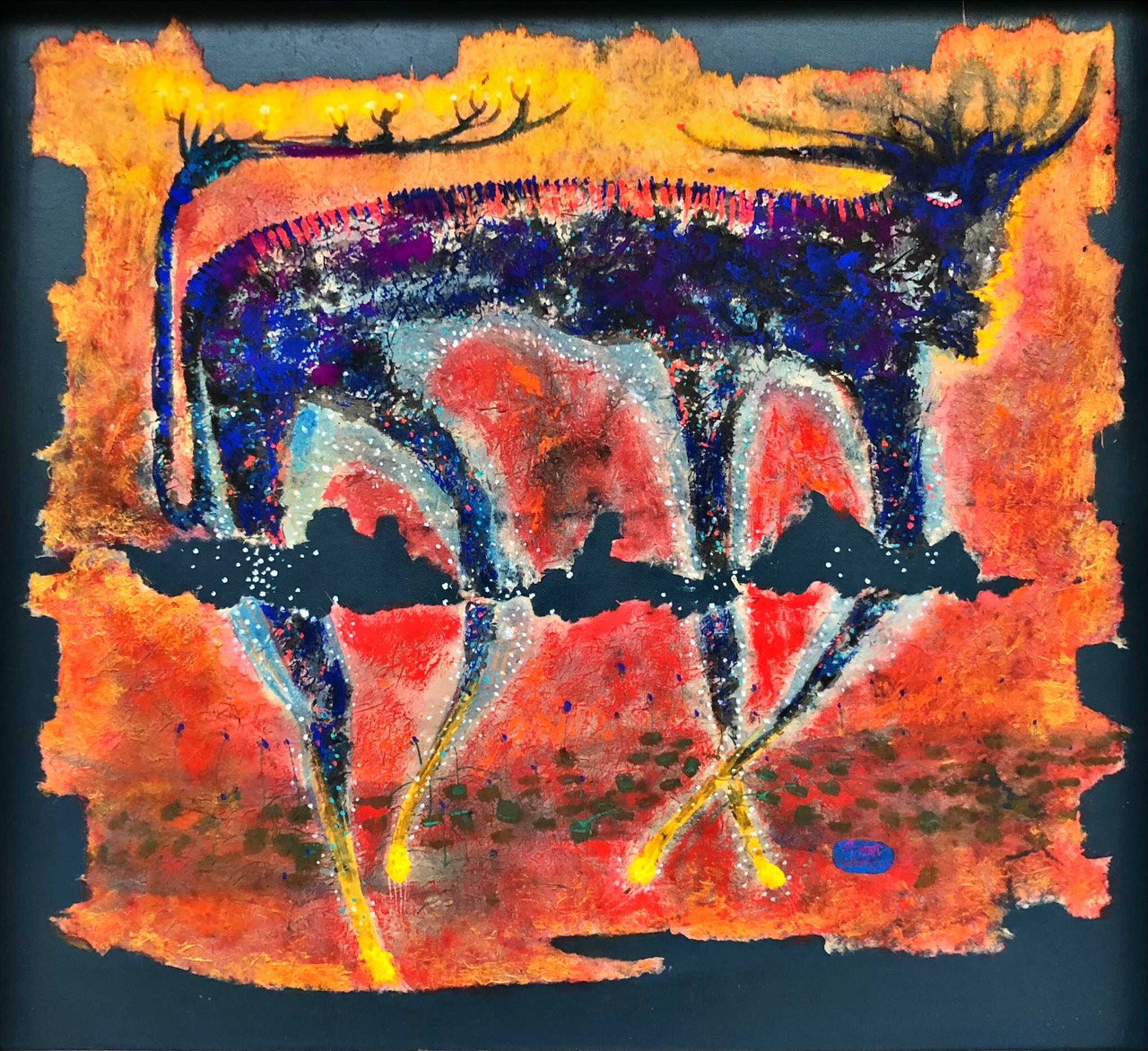
Nguyễn Văn Trinh, “Predator”, tempera, watercolor on Giang paper, 45 x 48 cm. Part of the “Living Zone 2” series. Photo credit: The Muse Artspace.
How do your earlier works relate to “Living Zone 1” in 2020 and “Living Zone 2” in 2022?
Actually, it's a whole, a world. The mechanical works are becoming clearer, actualized, transforming into a living zone. Before, the living zone was vague, chaotic. The molding and movement within were not clear. "Living Zone 2" is an evolution that forms distinct individuals. I am gradually building a world for myself, and living in it, gradually painting it rather than using pre-existing elements.
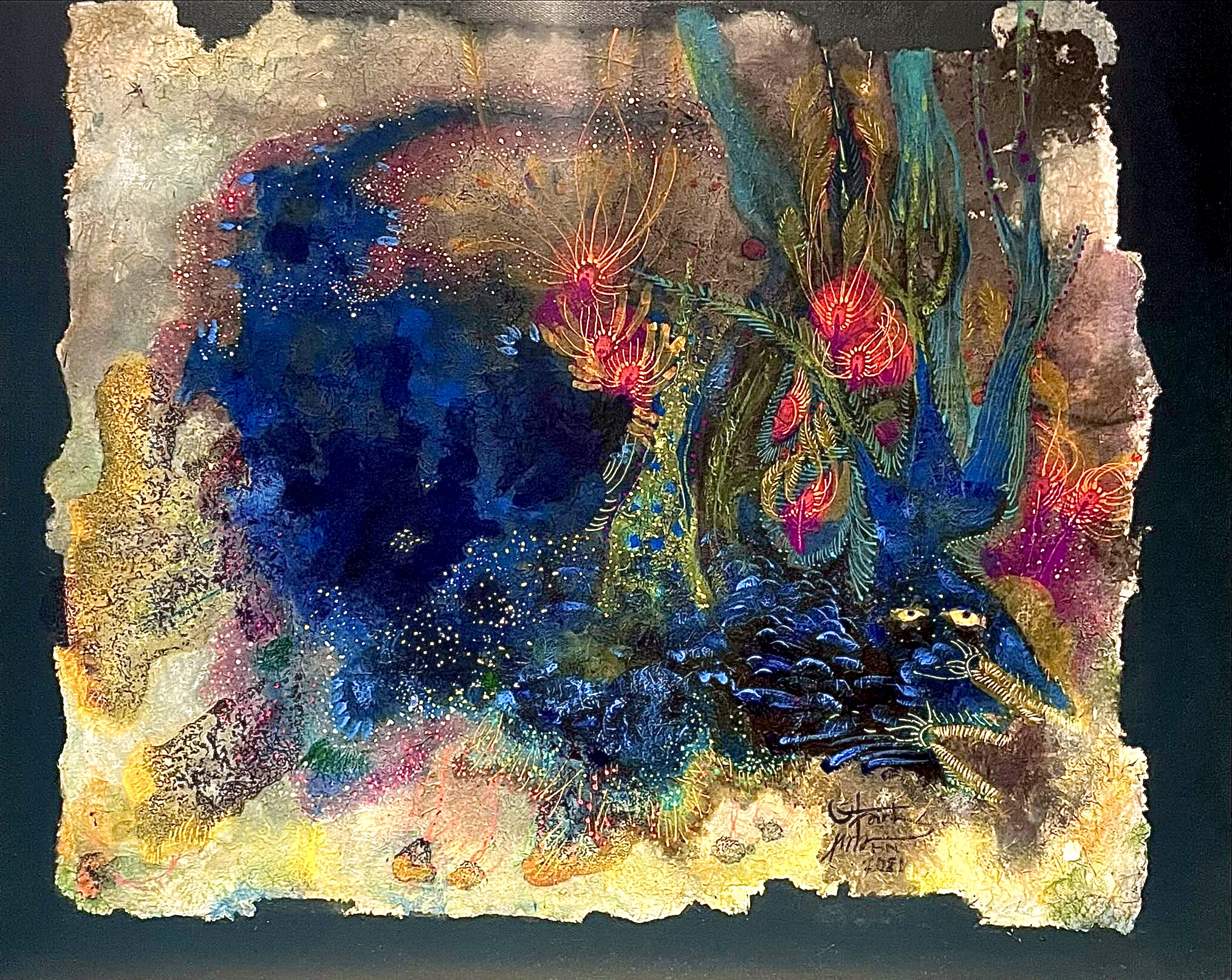
Nguyễn Văn Trinh, “Real Star Species”, tempera, watercolor on Giang paper, 60 x 80 cm. Part of the “Living Zone 2” series. Photo credit: The Muse Artspace.
Is “Living Zone 2” also a shift in materials and techniques?
That's right, "Living Zone 2" features changes in every element. Giang paper itself, made by the H'Mong people, is probably not used for drawing or writing but primarily for printing, for ritualistic purposes; therefore, Giang paper has very high absorbency. With Giang paper, I use tempera – a simple, rustic material crushed from minerals, earth, and stone. By mixing it with different glues and solvents, it becomes different types of paint such as oil paint, watercolor, wax crayons... I use tempera because the pigment particle size in tempera is large, the amount of solvent is small, which doesn't hinder the expression of the pigment's hue, preserving its full intensity. The large pigment particles on the surface create a great expressive power.
Regarding the technique, with this material, there are two approaches: One is to apply watercolor first and then paint with opaque colors on top. The second is to apply watercolor washes after painting the opaque parts.
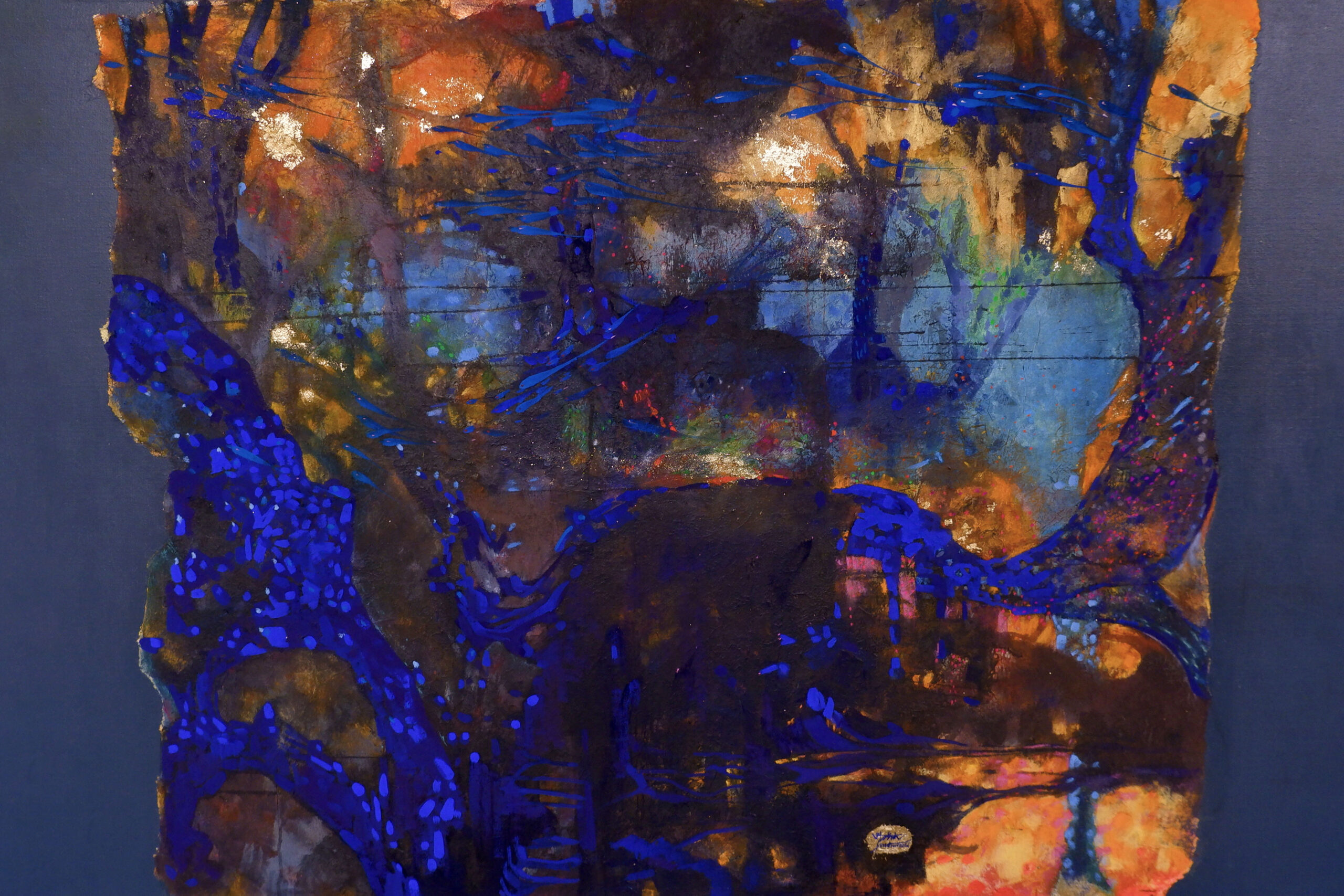
Nguyễn Văn Trinh, “Living Zone”, tempera, watercolor on Giang paper, 120 x 180 cm. Part of the “Living Zone 2” series. Photo credit: The Muse Artspace.
I feel that in “Living Zone 2,” you allow many random elements in your creation?
If we think of evolution, then the mind must also evolve. The first random element here is the preparation. I have a chassis, I take a relatively smaller sheet of paper, place it on top, look at the paper itself, it already has a language of form, I preserve some of its individuality and then combine it with my own to create a work of art.
Giang paper is also made very naturally. The paper pulp itself is roughly ground by hand, so it's not refined into a fine pulp like other industrial papers. Thus, the paper still has thick fibers protruding from its surface. Sometimes I even see dead insects embedded in it, and they just coat over them. These natural elements inspire me.
Next is the conductive material: water. Using water to guide and create uncontrolled bleeding, which is inherently a random shaping process.
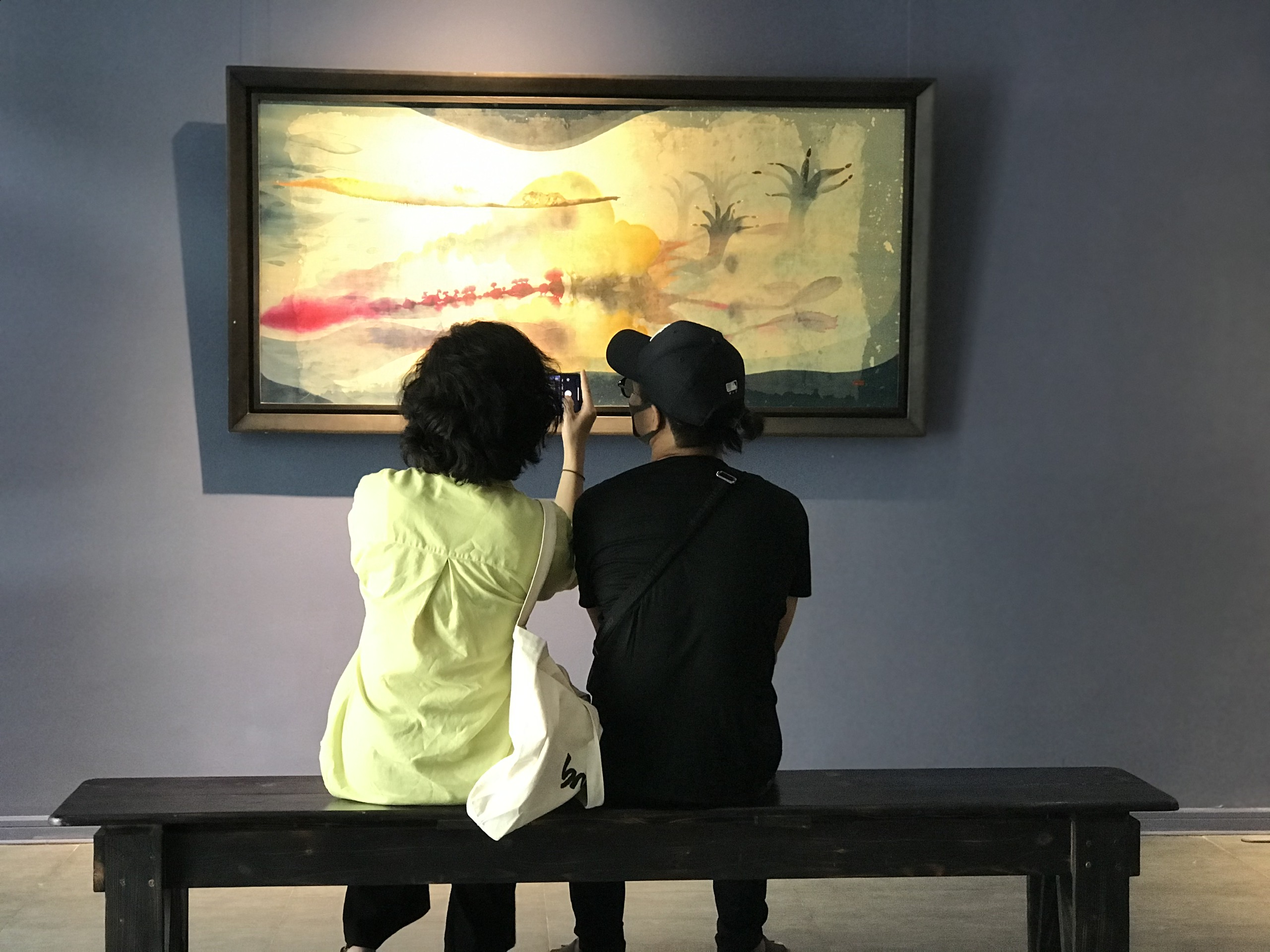
Audience viewing artist Nguyễn Văn Trinh’s “Living Zone 2” exhibition at The Muse Artspace. Photo: Trần Thu Huyền
Thank you, Trinh, for your interesting insights, and may your living zones continue to take shape!
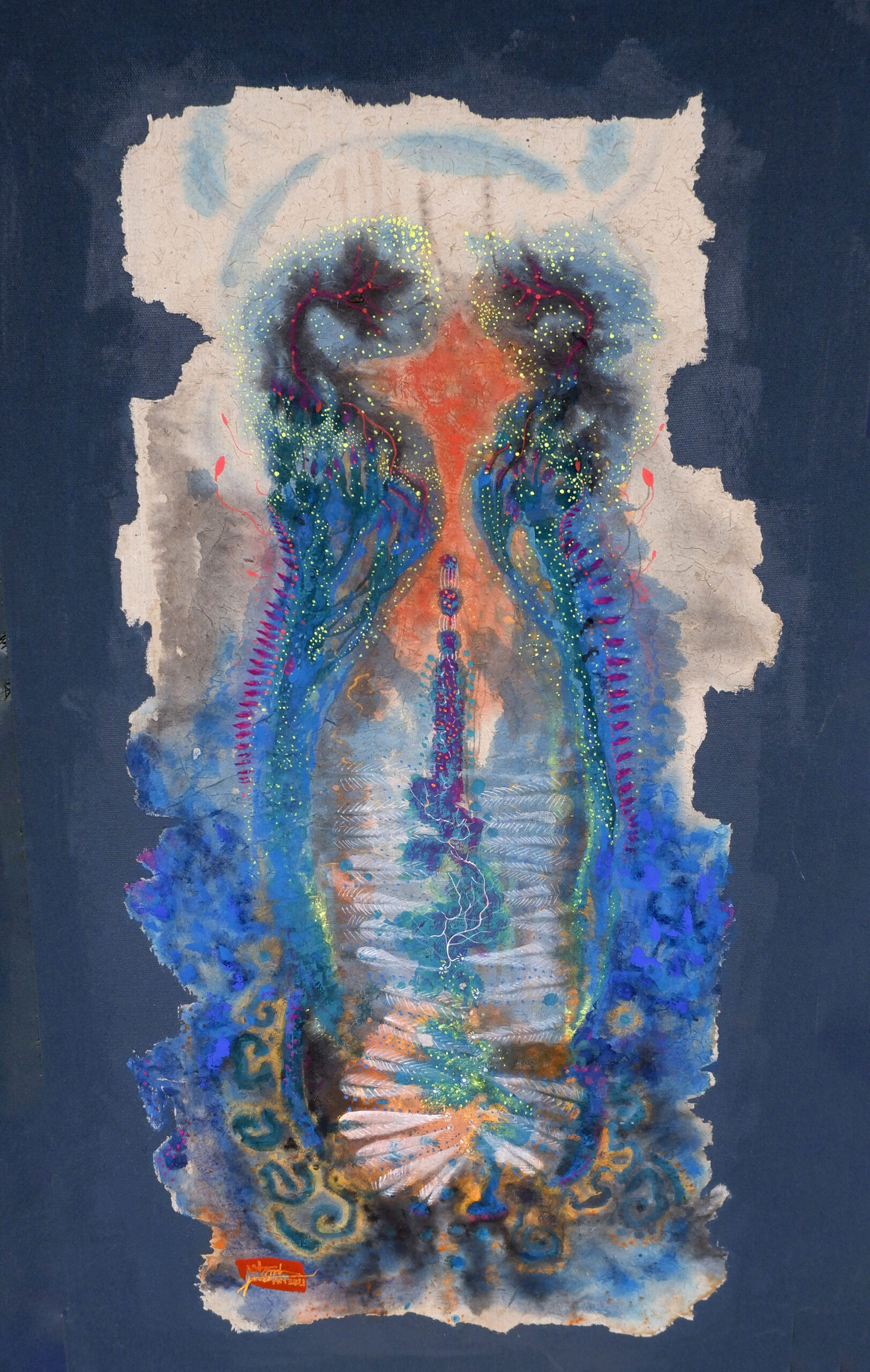
Nguyễn Văn Trinh, “Shadow Species”, tempera, watercolor on Giang paper, 105 x 60 cm. Part of the “Living Zone 2” series. Photo credit: The Muse Artspace.
“Living Zone 2” - a fantastical world
The works in "Living Zone 2" are given captivating titles such as: "Shadow Species," "Predator Species," "Real Star Species"... These can be considered fantastical creatures that have evolved from the chaotic world in Nguyễn Văn Trinh's "Living Zone 1." The intrigue comes from many angles, including form, texture, technique, and the space within the artwork.
The edges of the Giang paper are naturally torn, mounted onto a layer of canvas underneath, creating two or more physical spatial layers. The living zone varies in size. The largest work is 120 x 180 cm, while the smallest is around 30 x 40 cm, featuring various frame sizes and proportions of canvases and papers.
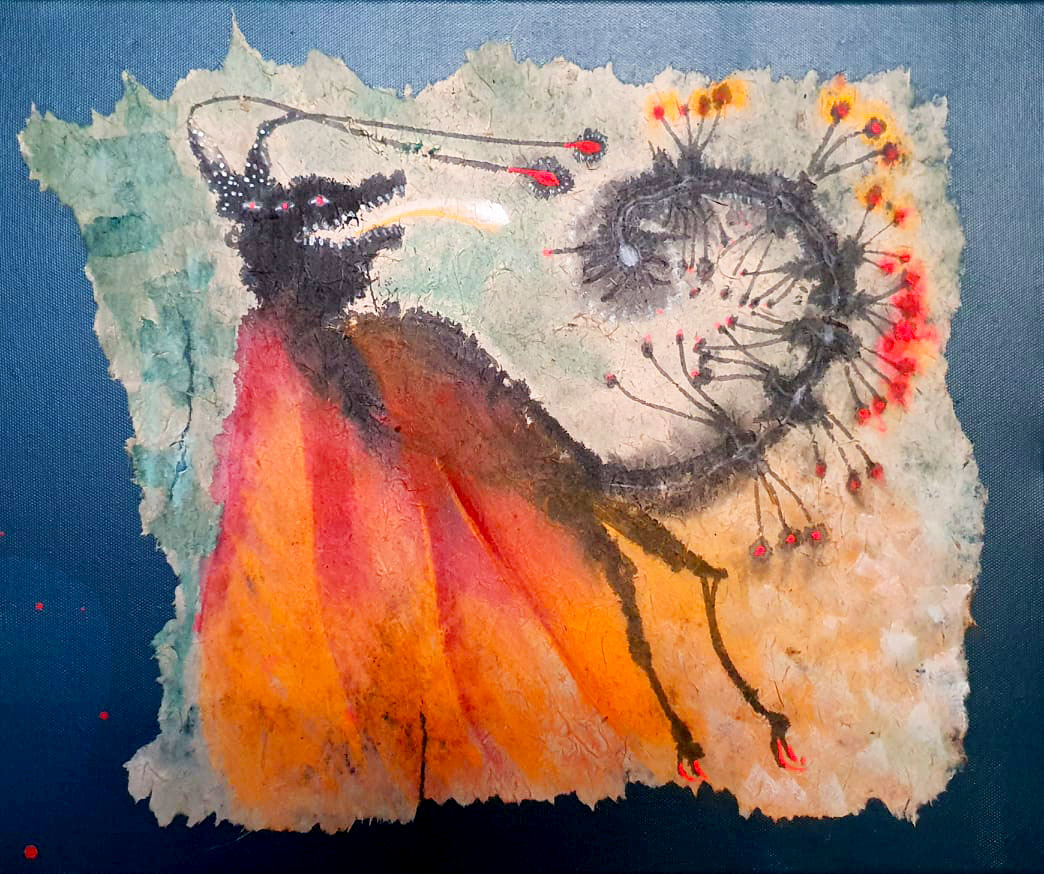
Nguyễn Văn Trinh, “Predator Species”, tempera, watercolor on Giang paper, 33 x 40 cm. Part of the “Living Zone 2” series. Photo credit: The Muse Artspace.
The tempera in the work creates areas of pigment that are sometimes thick, sometimes thin, combined with watercolors bleeding into the raised paper fibers, with some areas gilded with gold leaf. The colors in "Living Zone 2" are very strong contrasts. Primary colors are dominantly used, from which variations of hues emerge, expressing an extreme range of oscillation. The richness in form, line, dot, drip, and color blocks brings both intentional and accidental artistic marks. Among them, the intentional lines create meaning, while the accidental elements express the artist's mindset and style.
A striking impression is that Nguyễn Văn Trinh's "Living Zone 2" appears full of surprises. The creatures seem to burst forth from a chaotic, climactic world. They embody invasion, arrogance, and mystery. All of this reveals Nguyễn Văn Trinh's rich inner world and progressive fantasies. This will lead to unpredictable creative directions in his future art.